

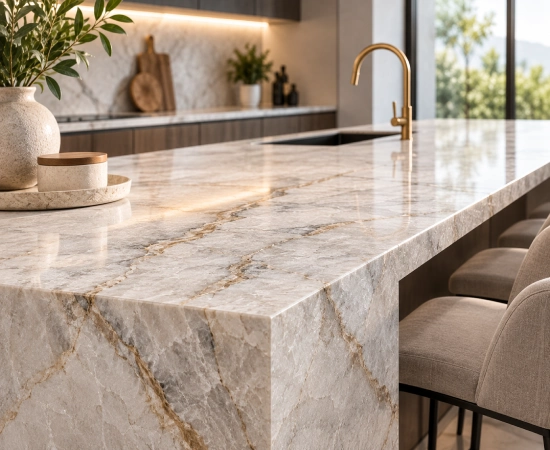
Choosing a kitchen countertop often comes down to a familiar comparison: marble for its elegance or granite for its durability. But there is another natural stone that deserves serious consideration; quartzite.
Formed naturally from sandstone under intense heat and pressure, quartzite is known for its hardness, distinctive patterns, and sophisticated appearance. Certain varieties have flowing veins and soft colours reminiscent of marble, while offering the robust characteristics expected from a hard natural stone.
For homeowners, architects, and interior designers exploring quartzite countertops in India, this combination makes the material particularly attractive for premium kitchens, islands, bar counters, and other frequently used surfaces.
Here’s what you should know before selecting quartzite for your project.
What Is Natural Quartzite?
Quartzite is a metamorphic natural stone. Over geological time, quartz-rich sandstone is transformed by heat and pressure, producing a dense stone composed predominantly of quartz.
One reason designers appreciate natural quartzite slabs is their visual diversity. Depending on the variety, slabs may feature white, cream, beige, grey, green, or other tones, accompanied by subtle or dramatic natural movement.
It is important not to confuse quartzite with quartz. Quartzite is quarried natural stone, whereas quartz countertops are engineered products typically manufactured from quartz particles combined with binders and pigments.
If natural stone is a priority for your project, that distinction matters.
Why Choose Quartzite for Kitchen Countertops?
A countertop has to withstand considerably more than a decorative wall. Food preparation, cookware, spills, cleaning, and frequent contact all place demands on the surface.
Quartzite offers several qualities that suit this environment.
1. High Natural Hardness
Quartzite is generally a hard natural stone, making it resistant to everyday scratching when properly selected and finished.
That doesn’t mean the surface is indestructible. Cutting boards are still recommended to protect both the countertop finish and your knives.
2. Marble-Like Visual Appeal
For many buyers, quartzite’s greatest attraction is its appearance.
Some varieties offer flowing veins and light backgrounds that can evoke the elegance associated with marble. This makes quartzite suitable for kitchens where visual sophistication is important but greater surface hardness is also desired.
Large islands are especially effective at showcasing the movement of a full natural slab.
3. Good Heat Resistance
Natural quartzite is formed under geological heat and pressure and generally performs well around heat, making it a strong candidate when buyers are searching for a heat-resistant countertop stone.
Even so, using trivets beneath very hot cookware remains sensible. Countertop performance can also be influenced by sealers, adhesives, resins, and fabrication details, not only the stone itself.
4. Every Slab Is Distinctive
Natural stone offers individuality that manufactured patterns cannot exactly reproduce.
Veining, mineral deposits, colour transitions, and other geological features differ from one quartzite slab to another. This gives kitchens and islands a more individual architectural character.
Quartzite vs Marble: Which Is Better for a Kitchen?
The quartzite vs marble comparison is especially relevant for homeowners who appreciate expressive natural veining.
Marble has a timeless character and remains an exceptional material for luxury interiors. However, because marble is primarily calcite-based, acidic ingredients such as lemon juice and vinegar can etch its surface.
True quartzite is quartz-rich and is generally harder and more resistant to acid etching than marble. That can make it attractive for busy countertop applications.
Marble may still be preferred when a specific marble variety, colour, or classical aesthetic is central to the design. Quartzite becomes compelling when the objective is to combine natural veining with harder surface characteristics.
The right choice ultimately depends on the individual stone and how the kitchen will be used.
Quartzite vs Granite: What’s the Difference?
The quartzite vs granite decision is less about finding a universal winner and more about balancing appearance and performance.
Both are hard natural stones commonly considered for demanding surfaces. Granite is an igneous rock available in an extensive range of colours and patterns. Quartzite is metamorphic and often has flowing visual movement that can appeal to buyers looking for a marble-inspired aesthetic.
For a highly functional kitchen, both can be excellent candidates when the correct slab is chosen.
Quartzite may have the advantage when you want:
- A lighter, marble-like visual character
- Strong natural veining
- A statement kitchen island
- A premium contemporary appearance
Granite remains a proven option where its particular colour, pattern, availability, and practical characteristics better suit the project.
Where Can Quartzite Be Used?
Although kitchen countertops are one of its most popular applications, quartzite can be considered for several interior surfaces.
Depending on the specific stone and project requirements, applications may include:
- Kitchen countertops
- Waterfall islands
- Breakfast counters
- Bar counters
- Vanity tops
- Feature walls
- Table surfaces
- Selected flooring and wall applications
For large installations, viewing the complete slab is particularly important. Small samples cannot show how the veins will interact with the dimensions of the finished surface.
What to Check Before Buying Natural Quartzite Slabs
Not every stone marketed under a commercial name has identical characteristics. Buyers should therefore evaluate the actual slabs rather than relying solely on a product label.
Confirm the Stone Type
Ask your supplier whether the material is genuine natural quartzite and understand how it differs from marble, granite, and engineered quartz.
Inspect the Full Slab
Look at the overall colour, vein direction, natural fissures, filled areas, edges, and surface finish.
Plan the Countertop Layout
For heavily veined slabs, decide where important features should appear before cutting. Sink and cooktop openings can affect the final composition.
Ask About Treatment and Sealing
Some natural stones are processed with resins or other treatments. Ask what has been applied and what maintenance is recommended.
Check Slab Dimensions and Thickness
Dimensions affect joint placement, fabrication, wastage, and whether a large island can be produced with the desired visual continuity.
A good countertop selection considers the entire slab, not merely its price per square foot.
Does Quartzite Require Maintenance?
Yes. Quartzite is durable, but natural stone still benefits from appropriate care.
Porosity varies between stones, so sealing requirements should be determined according to the particular slab, finish, and sealer being used.
For routine maintenance:
- Clean spills promptly
- Use cleaners suitable for natural stone
- Avoid unnecessarily harsh chemicals
- Use chopping boards during food preparation
- Place trivets beneath very hot cookware
- Follow professional recommendations for sealing
Correct care helps preserve both the finish and natural appearance of the surface.
What Affects Quartzite Counter top Prices in India?
There isn’t one standard price for quartzite counter tops in India. Natural stone pricing varies considerably according to the specific material and project.
Factors that can influence cost include:
Origin and variety: Certain imported quartzites are rarer or more sought after.
Slab quality: Colour, pattern, condition, and overall selection can affect value.
Slab dimensions: Large-format slabs may carry different pricing depending on availability.
Fabrication: Sink cut-outs, cooktops, waterfall edges, mitred details, and other custom work add to the overall project.
Installation: Handling and installing large natural slabs requires appropriate expertise.
Vein matching: Projects requiring precise continuity across multiple pieces may need additional planning and material.
Instead of comparing stone only by its headline rate, consider the complete installed requirement and the characteristics of the actual slabs being offered.
FAQs About Quartzite Counter tops
Is quartzite suitable for Indian kitchens?
Yes. Its natural hardness, appearance, and heat resistance make quartzite a strong counter top option. The specific slab should still be assessed for porosity, finish, fabrication requirements, and maintenance.
Is quartzite better than marble for counter tops?
Quartzite is generally harder and more resistant to acidic etching than marble, making it attractive for demanding kitchens. Marble remains an excellent choice when its particular aesthetic is the priority.
Is quartzite the same as quartz?
No. Quartzite is natural stone quarried from the earth. Quartz countertops are engineered surfaces made using quartz particles with binders and other materials.
Does quartzite stain?
Some quartzites can absorb liquids depending on their porosity. Appropriate sealing and prompt spill cleanup can reduce the risk of staining.
Can hot pans be placed directly on quartzite?
Quartzite itself generally has good heat resistance, but using trivets is recommended because sealers and other components of the installed countertop can respond differently to high temperatures.
Explore Premium Quartzite at Adi Marble
For homeowners seeking natural stone beyond conventional countertop choices, quartzite offers an appealing balance of visual character and practical performance.
At Adi Marble, homeowners, architects, and interior designers can explore premium marble, quartzite, and other natural stone options for kitchens, countertops, islands, flooring, feature walls, and bespoke interior applications.
Viewing natural quartzite slabs in person allows you to compare their colour, veining, dimensions, and individual character before deciding which stone works best for your project.
📍 Visit Us: Chintamani Park Road, Borate Vasti, Tukaram Nagar, Kharadi, Pune, Maharashtra 411014
📞 Call Us: +91-9168633149
🌐 Website: https://adimarble.in
Bring lasting strength and natural beauty to your kitchen with Adi Marble.