

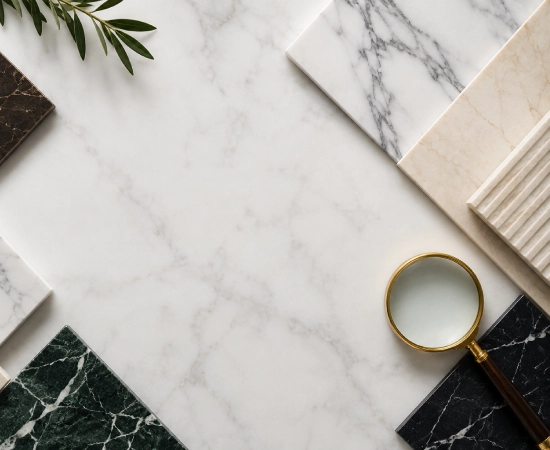
Italian marble has earned its place in premium interiors for good reason. Its distinctive veining, refined colours, and natural character can transform flooring, walls, staircases, bathrooms, and statement surfaces. But when you’re investing in imported stone, appearance alone isn’t enough to establish its origin or quality.
Two slabs that look similar in a showroom may differ considerably in geological origin, grade, treatment, structural condition, and price. That makes knowing how to identify Italian marble particularly important before placing a large order.
If you’re considering genuine Italian marble for your home or commercial project, these seven checks can help you evaluate a slab more carefully and have a better-informed conversation with your supplier.
1. Verify the Marble’s Origin and Documentation
Start with the most fundamental question: Where did the stone come from?
“Italian marble” refers to marble quarried in Italy; it isn’t simply a description for white marble or a particular style of veining. Ask the supplier to clearly identify the variety and declared country of origin.
Depending on the supply chain and purchase, relevant commercial documentation may help establish provenance. For larger projects, architects and buyers can also request available product or import details from the supplier.
Names such as Carrara, Calacatta and Statuario are closely associated with Italian marble, but a familiar trade name by itself shouldn’t be treated as proof of origin.
For buyers comparing premium slabs, traceability is a more meaningful starting point than assumptions based purely on appearance.
2. Examine the Veining Across the Entire Slab
Natural marble doesn’t look printed. Its mineral formations create organic variations that develop across the stone.
When conducting an Italian marble quality check, step away from the slab and inspect it as a whole. Then move closer to study the veins, transitions and smaller details.
Look for:
- Natural variation rather than mechanically repeated patterns
- Depth and movement within the veining
- Changes in vein width and intensity
- Subtle tonal variations across the slab
- Character that remains visually natural rather than overly uniform
Statuario may display a bright base with prominent grey veins, while Calacatta is known for bolder movement and can feature warmer accents. Carrara generally has a softer grey-white appearance with finer veining.
Remember, however, that veining helps distinguish varieties and select slabs; it doesn’t independently authenticate geographic origin.
3. Check Slab Consistency Across the Lot
One beautiful slab doesn’t guarantee that every slab in your order will work equally well for the project.
If you’re buying marble for a large floor, lobby, staircase, or wall, ask to inspect the slabs intended for your order together. Natural variation is expected, but excessive differences in tone or pattern can affect the finished design.
Check for consistency in:
- Background colour
- Overall visual character
- Thickness
- Finish
- Vein intensity
- Slab dimensions
For continuous flooring or wall cladding, slab selection and sequencing can be particularly important.
If the design requires bookmatching, inspect adjacent slabs before fabrication. This allows your architect or designer to plan the pattern rather than discovering mismatched movement during installation.
4. Ask About Resin, Mesh and Other Treatments
This is an area where buyers often misunderstand natural stone.
The presence of resin or backing doesn’t automatically mean a marble slab is fake or poor quality. Certain natural stones are resin-treated or reinforced during processing to improve stability, fill small natural voids, or support fragile sections.
The important issue is transparency.
Ask the dealer whether the slab has:
- Resin treatment
- Fibreglass mesh backing
- Filled fissures or voids
- Surface repairs
- Reinforced sections
Look at the front, edges and back of the slab rather than evaluating only the polished face.
A professional supplier should be able to explain the treatment and help determine whether that particular slab is suitable for your intended application.
5. Measure the Marble Thickness
Thickness matters for performance, fabrication and installation.
Don’t estimate it visually. Ask for the actual slab thickness and confirm that the material is appropriate for where it will be installed.
Requirements can differ for:
- Flooring
- Wall cladding
- Staircases
- Vanity counters
- Feature walls
- Custom architectural applications
Consistency is also important. Significant thickness variation between slabs can complicate fabrication and installation.
A reliable Italian marble dealer in Pune should discuss thickness in relation to the application rather than presenting one specification as ideal for every project.
6. Inspect Cracks, Fissures, Edges and Filled Areas
Marble is a natural geological material, so veins, mineral lines and certain natural fissures are part of its character. A fissure isn’t necessarily the same thing as a structural crack.
Before buying, inspect each slab under good lighting.
Pay particular attention to:
- Corners and edges
- Hairline cracks
- Large filled areas
- Surface pits
- Resin-filled sections
- Chips or handling damage
- Areas where veins intersect the slab edge
For expensive statement slabs, involve your architect, fabricator, or stone professional if there’s uncertainty about structural suitability.
The objective isn’t to find a perfectly uniform piece of stone. It’s to understand exactly what you’re purchasing and whether its natural characteristics are appropriate for the proposed application.
7. Be Cautious of Pricing That Doesn’t Match the Stone
Price matters, but unusually low pricing deserves investigation when a material is being sold as a rare premium variety.
The price of original Italian marble can vary according to the quarry and variety, slab dimensions, grade, colour, vein pattern, processing, treatment, availability, and market conditions. Two slabs carrying the same broad marble name can therefore have different values.
Price per square foot is important, but it shouldn’t be the only factor guiding your marble purchase, you should also ask:
- What exact marble variety is this?
- What is its country of origin?
- What grade or selection is being offered?
- Is the slab treated or reinforced?
- What are its dimensions and thickness?
- Does the quotation cover only the slab or additional services?
A transparent quotation is far more useful than comparing headline rates without understanding what they include.
Genuine Italian Marble: What Should You Prioritize?
There isn’t one visual test that can reliably prove authenticity in every case. A better buying process combines provenance, slab inspection, technical suitability, transparent treatment information and supplier credibility.
Before confirming an order, review the material in person whenever practical. If multiple slabs are required, evaluate the complete lot and discuss the layout with your architect or designer.
For high-value projects, the right question isn’t simply which marble looks best. It is which stone offers the right origin, quality, visual character and technical suitability for the application.
Frequently Asked Questions
1] How can I identify genuine Italian marble?
Ans: Start by confirming the stated origin and marble variety with the supplier. Then evaluate the complete slab for natural veining, finish, thickness, condition and disclosed treatments. Appearance alone shouldn’t be used as proof of origin.
2] Is all white marble Italian marble?
Ans: No. White marble is quarried in several countries. Color alone cannot establish where a stone originated.
3] Does resin treatment mean Italian marble is low quality?
Ans: Not necessarily. Resin and reinforcement can be part of natural-stone processing. What matters is understanding the treatment, the condition of the slab and its suitability for the intended application.
4] Which Italian marble is best for luxury interiors?
Ans: Statuario, Calacatta and Carrara are well-known options, but the best choice depends on the individual slab, application, design preference, availability and budget.
5] Where can I view Italian marble in Pune?
Ans: Buyers looking for an Italian marble dealer in Pune can visit Adi Marble in Kharadi to explore marble and natural stone options in person.
Choose Italian Marble with Greater Confidence at Adi Marble
Buying premium marble should involve more than selecting a photograph or choosing a familiar stone name. Seeing the slabs in person allows you to compare their colour, veining, scale and overall character before making an investment.
At Adi Marble, homeowners, architects, interior designers and project professionals can explore premium marble and natural stone options for residential and commercial applications. Our team can assist with material selection based on your project’s aesthetic and functional requirements.
Whether you’re considering marble for flooring, a staircase, wall cladding or a statement interior feature, visit the showroom and examine the stone before making your final selection.
📍 Visit Us: Chintamani Park Road, Borate Vasti, Tukaram Nagar, Kharadi, Pune, Maharashtra 411014
📞 Call Us: +91-9168633149
🌐 Explore More: https://adimarble.in
Step into elegance. Step into Adi Marble.