

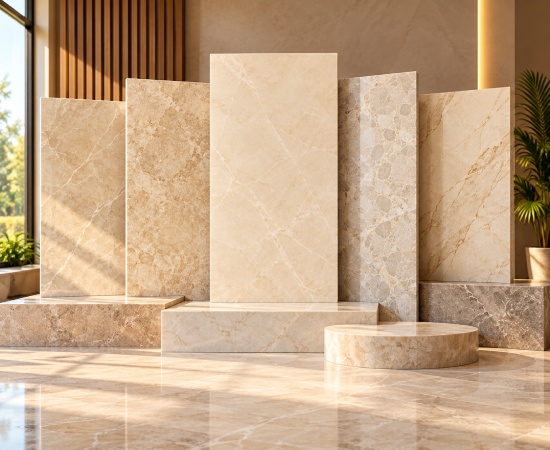
White marble may create brightness and grey marble can bring contemporary contrast, but beige has a different strength: warmth.
Beige marble sits comfortably between classic and contemporary design. It can soften large floors, complement wooden furniture, work beautifully with cream and earthy palettes, and give an interior a refined appearance without demanding too much visual attention.
Yet choosing beige marble isn’t simply a matter of picking a shade. Different beige marble types can vary noticeably in undertone, veining, fossil-like markings, pattern density, and overall character. Botticino, Perlato and Crema Marfil, for example, may belong to a similar colour family, but they don’t create the same interior effect.
Understanding these differences can help you choose a stone that works with the architecture rather than simply looking attractive on its own.
Why Beige Marble Works So Well in Indian Interiors
Beige is remarkably adaptable.
It pairs naturally with materials already common in premium Indian homes—wood, brass, bronze, cream upholstery, warm lighting and earthy wall colours. It can also bridge traditional furniture and contemporary architecture without making either feel out of place.
This is particularly useful across large flooring areas. Highly dramatic stone can become visually dominant when repeated throughout a home, whereas warm tone marble flooring can provide continuity while allowing furniture, artwork and architectural details to stand out.
Beige also doesn’t mean plain. Depending on the stone, you can find everything from quiet cream backgrounds to noticeable veins and distinctive natural markings.
Botticino Marble: Understated Italian Warmth
Botticino marble is one of the better-known names in the beige natural-stone category. Associated with the Botticino area of northern Italy, it typically presents a warm beige-to-cream background with natural veins and characteristic markings.
Its visual strength is subtlety.
Rather than creating the high contrast associated with some white Italian marbles, Botticino can form a calmer backdrop. That makes it suitable for interiors where the stone needs to look premium without becoming the room’s dominant feature.
It can be considered for applications such as flooring, wall cladding, staircases and decorative interior elements, subject to the characteristics of the particular slab and project requirements.
Where does Botticino look best?
Botticino can work especially well in living rooms, entrance areas and interiors featuring walnut or other warm-toned woods. Cream upholstery, brass details and soft lighting can reinforce its naturally warm character.
For homeowners who like beige Italian marble but prefer restrained movement over dramatic veining, Botticino is worth viewing in full slabs.
Perlato Marble: More Natural Movement
Perlato is another name buyers frequently encounter when exploring warm-toned marble.
Depending on the specific commercial variety, Perlato marble generally sits within a cream-to-beige palette and may show more visible natural markings or fossil-like details than a very uniform beige stone.
That extra movement can be an advantage.
On a large floor, subtle pattern variation prevents the surface from appearing flat. On stairs or wall applications, it can introduce natural texture without the strong contrast of bold grey or black veining.
Perlato can suit interiors that need warmth but still benefit from visible stone character.
However, buyers should inspect the actual slabs rather than make a decision based solely on the name. Natural variation—and the fact that commercial naming can differ across markets—means one selection may not look identical to another.
Crema Marfil: Soft Spanish Beige
Crema Marfil is a widely recognised beige natural stone associated with Spain. Its appearance generally ranges from pale cream to warmer beige, with veining and other natural characteristics varying from slab to slab.
Visually, it can create an elegant, composed surface across larger areas.
That makes Crema Marfil appealing for spacious living rooms, passages, entrance areas, bathrooms and other interiors where a warm neutral foundation is desired.
It can also coordinate particularly well with off-white walls and darker furniture. The contrast is noticeable enough to define the space without creating a sharp visual break.
Like other marbles, Crema Marfil should be evaluated for the intended application, finish and maintenance requirements rather than selected on appearance alone.
Botticino vs Perlato vs Crema Marfil: How Do They Feel Different?
When these stones are viewed separately, they can all simply register as “beige.” Place full slabs next to one another and their individual personalities become much easier to recognise.
Botticino often suits buyers looking for an understated, warm Italian aesthetic.
Perlato can appeal when you want beige with more visible natural movement and character.
Crema Marfil is known for its creamy Spanish beige appearance and can create a soft, expansive look across larger surfaces.
These descriptions are useful starting points—not substitutes for slab selection. Natural stone is inherently variable, and the exact colour, veins and markings of the material available for your project matter more than a catalogue image.
Other Beige and Warm-Toned Marbles Worth Exploring
Botticino, Perlato and Crema Marfil aren’t the only possibilities.
Stone showrooms may carry several cream, ivory, taupe and beige-toned imported or Indian materials under different commercial names. Some have almost uniform backgrounds, while others feature sweeping veins, cloudy movement or contrasting mineral patterns.
Instead of beginning with a name alone, consider beginning with the effect you want.
Do you need a quiet floor that runs throughout the home? A beige staircase with visible character? A warmer alternative to white marble? Or a feature surface that needs stronger veining?
Once that is clear, comparing actual slabs becomes much more productive.
Choosing Beige Marble by Room
The same beige stone doesn’t automatically suit every part of a home.
Living Rooms and Large Floors
For expansive flooring, consider how the slabs will look collectively rather than individually. A relatively balanced background can provide visual continuity, while natural variations keep the floor from appearing artificial.
Slab planning is particularly important across large open-plan areas.
Bedrooms
Beige marble can complement the softer palette typically preferred in bedrooms. Warm woods, fabric headboards and indirect lighting can work particularly well with cream and beige stone.
Staircases
A staircase provides an opportunity for slightly stronger natural movement because each tread and riser creates its own visual frame.
Finish and slip considerations should also form part of the selection process, particularly for frequently used stairs.
Bathrooms
Warm beige stone can make a bathroom feel softer than a stark white or dark grey scheme. It pairs naturally with brushed metal finishes, wood-look cabinetry and warm lighting.
As with any wet-area marble installation, the appropriate finish, detailing, sealing requirements and maintenance should be discussed with the relevant stone and installation professionals.
Polished or Honed Beige Marble?
Finish changes the personality of marble almost as much as colour.
A polished finish enhances reflectivity and can make beige tones and natural patterns appear richer. It is often selected where a more formal, luxurious appearance is desired.
A honed finish is less reflective and creates a softer, more understated surface.
The right choice depends on the application, desired appearance and practical requirements. For flooring in particular, finish selection should also account for expected traffic and slip considerations.
Don’t Choose Beige Marble from a Small Sample
This is one of the most important steps when buying natural stone.
A small sample may show the colour, but it can’t properly communicate the slab’s overall movement.
When comparing beige marble types, view full slabs and look for:
- Undertone—cream, yellow-beige, taupe or warmer beige
- Vein intensity and direction
- Natural markings and variation
- Slab dimensions and thickness
- Surface finish
- Filled, resin-treated or reinforced areas where applicable
- Consistency between slabs required for the project
If several slabs will be installed together, viewing the relevant lot can also help with layout planning.
Beige Marble Isn’t About Following a Trend
Interior colour preferences change, but warm neutrals have a practical advantage: they work with a broad range of materials.
A beige marble floor installed today can accommodate changes in furniture, wall colours and décor years later. You can move from traditional dark wood to contemporary beige furniture without necessarily needing to redesign the stone surfaces around it.
That flexibility is one reason beige continues to have a place alongside more dramatic contemporary marble colours.
FAQs
Which beige marble is best for home flooring?
There isn’t one universally best variety. Botticino, Perlato, Crema Marfil and other beige stones offer different colours and natural patterns. The best choice depends on the room, slab characteristics, desired finish, maintenance expectations and overall interior palette.
Is Botticino marble good for modern interiors?
Yes, Botticino’s warm and relatively understated appearance can complement modern interiors, particularly when paired with wood, cream, beige and muted metallic finishes.
What is the difference between Botticino and Crema Marfil?
They are distinct natural stones associated with different geographic origins. Botticino is associated with Italy, while Crema Marfil is associated with Spain. Their tone, veining and natural characteristics also differ, and actual slabs should be compared before purchase.
Does beige marble make a room look dated?
Not inherently. The final appearance depends heavily on slab selection, layout, furniture, lighting and surrounding materials. Beige marble paired with clean detailing and contemporary finishes can create a distinctly modern interior.
Is beige marble difficult to maintain?
Like other natural marble, it requires appropriate care. Acidic substances can etch calcite-based marble, and spills should be cleaned promptly. Sealing requirements vary according to the particular stone, finish, sealer and application.
Find the Right Shade of Warmth at Adi Marble
The difference between two beige stones can seem subtle in a photograph and striking when you see the full slabs side by side. That’s why choosing by colour name alone rarely tells the whole story.
At Adi Marble, homeowners, architects and interior designers can explore marble and other premium natural stones for flooring, walls, staircases, bathrooms and bespoke interior applications. Viewing the stone in person helps you compare its true undertone, pattern scale, veining and overall relationship with your design palette.
📍 Visit Us: Chintamani Park Road, Borate Vasti, Tukaram Nagar, Kharadi, Pune, Maharashtra 411014
📞 Call Us: +91-9168633149
🌐 Website: https://adimarble.in
Some interiors need contrast. Others need warmth. Find your perfect shade in natural stone at Adi Marble.