

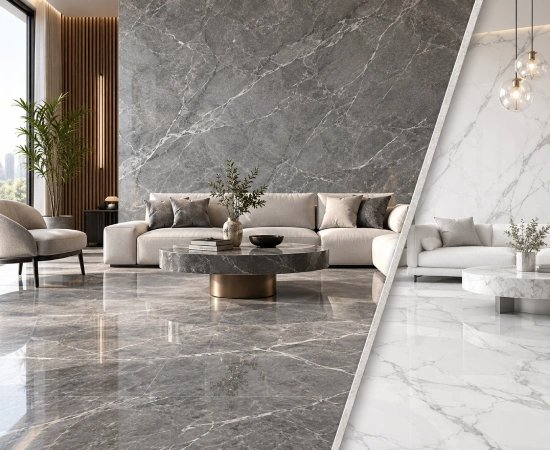
White marble has defined elegant interiors for generations. Its brightness, timeless character, and natural veining make it a dependable choice for everything from luxury flooring to statement walls.
But modern interiors are becoming warmer, moodier, and more layered. As homeowners and designers move beyond all-white spaces, grey marble for home interiors is gaining attention as a sophisticated alternative.
Grey marble can be understated or dramatic. Some slabs have a soft silver background with delicate veins, while others feature charcoal tones and bold natural movement. This versatility allows grey marble to work with contemporary furniture, warm woods, metallic finishes, glass, and neutral colour palettes.
So, should you choose grey instead of white? The answer depends on the space you’re creating.
Why Is Grey Marble Trending in Modern Interiors?
One reason is simple: grey offers depth without demanding excessive attention.
White marble naturally brightens a room, whereas grey can give it greater visual definition. In open-plan homes, it can help distinguish a floor, staircase, kitchen island, or feature wall without relying on strong colours.
Current modern interior marble trends also favour natural textures and materials with visible character. Grey marble fits this direction particularly well because its variations can complement minimalist spaces without making them feel plain.
Depending on the stone, grey marble can appear:
- Soft and understated
- Cool and architectural
- Warm and earthy
- Dark and dramatic
- Highly expressive when strongly veined
That range makes it much more versatile than the term “grey” might suggest.
Grey Marble vs White Marble: What’s the Difference?
The grey marble vs white marble decision should go beyond colour.
White marble reflects more light and can make compact interiors feel brighter and more spacious. It remains particularly effective in classical interiors, bathrooms, entrance areas, and spaces where a crisp visual palette is preferred.
Grey marble creates a different atmosphere. It can provide contrast, depth, and a stronger contemporary character.
For example, a grey marble floor combined with cream walls and warm wooden furniture can create an elegant neutral palette without looking monochromatic. Dark grey marble paired with glass and metal can produce a more architectural aesthetic.
Neither option is inherently better. The best stone is the one that supports the room’s proportions, lighting, furniture, and overall design language.
Where Does Grey Marble Work Best?
Grey marble isn’t limited to flooring. Its neutral palette makes it suitable for several architectural applications.
1. Grey Marble Flooring
Grey marble flooring can provide a strong foundation for contemporary interiors without dominating the furniture and décor.
Lighter grey stones work particularly well in living rooms and large open spaces, while deeper shades can create a more dramatic effect in selected areas.
Grey flooring also coordinates effectively with:
- Natural wood
- Beige and cream upholstery
- Black accents
- Brass or bronze details
- Glass partitions
- Neutral walls
Before selecting a slab, view it under lighting similar to the intended interior. Grey can appear considerably warmer or cooler depending on surrounding light.
2. Statement Living Room Walls
A large grey veined marble slab can transform an otherwise simple wall into an architectural feature.
Rather than adding several decorative finishes, designers can use the movement within the stone itself as visual artwork.
For strongly veined varieties, bookmatching can create an even more dramatic composition across a large feature wall.
3. TV Units and Media Walls
Grey is particularly effective behind television screens because it creates a softer contrast than a bright white background.
A marble TV wall can be paired with timber cabinetry, concealed lighting, or dark metal details to create a refined contemporary setting.
4. Kitchens and Islands
Grey marble can provide contrast in kitchens with light cabinetry and integrate naturally with darker kitchens.
For countertops, however, stone should never be selected on colour alone. The particular marble’s characteristics, porosity, finish, sealing requirements, and expected use should all be considered.
5. Bathrooms
Grey marble can create a calm, spa-inspired environment when paired with appropriate lighting and fixtures.
Using related grey tones across walls and floors can create visual continuity, while combining grey marble with lighter surfaces prevents compact bathrooms from appearing overly dark.
Light Grey or Dark Grey: Which Should You Choose?
The size and lighting of the room provide a useful starting point.
Light Grey Marble
Light grey works well when you want a contemporary look while retaining an open, airy feeling. It can be particularly effective for larger flooring areas because it adds subtle variation without making the interior visually heavy.
Dark Grey Marble
Charcoal and deeper grey stones make a stronger statement. They can work beautifully for feature walls, staircases, reception counters, bathroom vanities, and other focal surfaces.
In spaces with limited natural light, dark marble should be planned carefully so that the room maintains the desired visual balance.
Grey Veined Marble: Let the Natural Pattern Lead the Design
The appeal of grey veined marble isn’t simply its base colour. Vein movement can completely change the personality of the stone.
Fine, delicate veins produce a restrained effect suitable for minimalist interiors. Strong white or contrasting veins create more dramatic surfaces suited to feature applications.
When purchasing marble for a large area, inspect full slabs rather than relying on a small sample. Full-size viewing reveals:
- Vein direction
- Colour variation
- Pattern scale
- Natural fissures and characteristics
- How adjoining slabs may coordinate
For a feature wall or large island, slab selection can be as important as choosing the marble variety itself.
How to Style Grey Marble Without Making a Room Feel Cold
Grey has sometimes been associated with cool or industrial interiors, but the final atmosphere depends largely on what surrounds it.
Pairing grey marble with warm wood immediately softens the space. Oak, walnut, and other natural timber tones provide an effective contrast to stone.
Warm lighting can also highlight subtle undertones within the marble. Brass, bronze, and muted gold details introduce another layer of warmth.
Textured fabrics, beige furnishings, indoor greenery, and off-white walls can further balance the stone.
The result can feel sophisticated and welcoming rather than stark.
Is Grey Marble Practical for Indian Homes?
Yes, provided the specific stone is suitable for the intended application.
Like other natural marbles, grey marble can require appropriate sealing and maintenance. Acidic substances can etch marble surfaces, while certain liquids may stain inadequately protected stone.
For routine care, use products suitable for natural stone, clean spills promptly, and follow professional recommendations regarding sealing.
For flooring and other large installations, proper substrate preparation, fabrication, and installation are equally important to long-term performance.
Grey Marble and Contemporary Interior Colours
One reason grey is becoming prominent among contemporary marble colors is its ability to connect different materials within the same room.
It works particularly well with today’s popular interior palettes, including:
- Grey and natural oak
- Charcoal and beige
- Grey and ivory
- Grey with muted green
- Silver-grey with black accents
- Warm grey with brass
- Grey with off-white and natural textures
This flexibility makes grey marble suitable for both restrained luxury and bolder architectural interiors.
FAQs
Is grey marble good for home interiors?
Yes. Grey marble works particularly well in contemporary interiors because it offers a neutral foundation while adding natural texture, depth, and character.
Is grey marble better than white marble?
Neither is universally better. White marble generally creates a brighter appearance, while grey marble offers greater contrast and visual depth. The right choice depends on the room and design concept.
Where can grey marble be used?
Depending on the particular stone, grey marble can be considered for flooring, walls, staircases, bathrooms, TV units, vanities, and selected countertop applications.
Does grey marble make a room look smaller?
Not necessarily. Light grey marble can maintain an open appearance. Darker varieties require more careful coordination with room size, natural light, artificial lighting, and surrounding colours.
What colours pair well with grey marble?
Warm wood, ivory, beige, black, muted green, brass, bronze, and off-white can all coordinate effectively with grey marble.
Discover a Different Side of Marble at Adi Marble
White will always have its place in natural stone design, but today’s interiors don’t have to begin and end there. Grey marble for home interiors offers another way to create luxury through depth, contrast, texture, and understated natural colour.
At Adi Marble, homeowners, architects, and interior designers can explore premium marble and natural stone for flooring, feature walls, staircases, kitchens, bathrooms, and bespoke interior applications.
Seeing full slabs in person allows you to compare shades, understand vein movement, and find the grey that works with your project’s light, materials, and architecture.
📍 Visit Us: Chintamani Park Road, Borate Vasti, Tukaram Nagar, Kharadi, Pune, Maharashtra 411014
📞 Call Us: +91-9168633149
🌐 Website: https://adimarble.in
Move beyond ordinary neutrals. Discover the depth of grey marble at Adi Marble.