

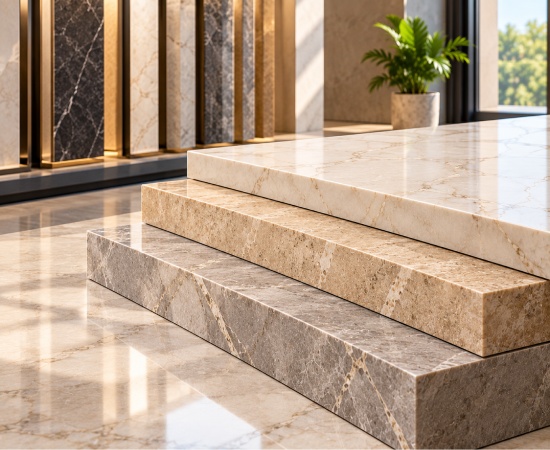
A marble slab can have the perfect colour and veining, but that doesn’t automatically make it suitable for every application. Thickness matters too.
The marble used for a feature wall doesn’t necessarily need the same specification as stone installed on a floor, staircase, or kitchen counter. Thickness influences weight, handling, fabrication, installation requirements and, together with the support beneath the stone, the performance of the finished surface.
When homeowners compare marble thickness for flooring, numbers such as 16mm, 18mm and 20mm frequently come up. But choosing between them isn’t as simple as assuming thicker is always better.
Here’s what those measurements actually mean—and what should determine your final choice.
What Does Marble Slab Thickness Mean?
Marble slab thickness is simply the distance between the front and back surfaces of the stone.
A nominal 18mm slab, for example, is intended to be approximately 18 millimetres thick. Because marble is a natural material that goes through cutting and finishing processes, buyers should confirm the actual finished thickness and acceptable tolerances with their supplier or fabricator.
Thickness is only one part of the specification.
The stone variety, slab dimensions, natural characteristics, resin or mesh reinforcement, substrate, fixing system, edge design and intended application can all affect what is appropriate.
That distinction is important because two slabs of the same thickness may not necessarily perform identically.
16mm vs 18mm vs 20mm Marble: What’s the Practical Difference?
Rather than treating these measurements as quality grades, it is more useful to understand where each may fit within a project.
16mm Marble: Lighter, but Application Matters
A 16mm slab uses less material and weighs less than a comparable 18mm or 20mm slab.
Depending on the stone, dimensions, fixing system and project design, thinner material may be considered for certain vertical or decorative applications. Reduced weight can be beneficial where wall loading and handling are important considerations.
However, thinner does not automatically mean suitable for every wall, nor should 16mm be selected for flooring simply to reduce cost.
Large-format pieces and demanding installations need appropriate engineering, support and fixing.
Potential applications may include:
- Selected interior wall cladding
- Decorative panels
- Low-stress vertical applications
- Certain fabricated elements designed for thinner stone
Suitability should always be confirmed for the actual slab and installation system.
18mm Marble: A Common Middle Ground
18mm marble is commonly encountered in interior stone projects because it offers a useful balance between material weight and thickness.
Depending on the marble, substrate and project specification, it may be considered for residential flooring, wall applications and other interior surfaces.
For flooring, however, the number alone doesn’t guarantee performance.
An 18mm slab installed over a properly prepared and supported substrate can behave very differently from the same material installed over an uneven or unsuitable base.
This is why architects, installers and stone professionals should evaluate the complete floor assembly—not simply the slab.
20mm Marble: More Material for Demanding Applications
A 20mm slab provides more stone thickness than 16mm or 18mm options and is often considered where greater section thickness is desirable.
It may be specified for certain floors, stairs, countertops, vanity tops and other fabricated surfaces, depending on design and support.
The trade-offs are straightforward: thicker stone is heavier and uses more material. That can affect transportation, handling, fabrication and overall project cost.
And even at 20mm, adequate support remains essential. Thickness should complement good installation—not compensate for poor preparation.
What Marble Thickness Is Best for Flooring?
There is no single thickness that is correct for every marble floor.
For many residential projects, specifications around 18–20mm may be considered, but the correct marble thickness for flooring depends on several variables:
- Type and characteristics of the marble
- Dimensions of individual pieces
- Quality and flatness of the substrate
- Installation method
- Expected foot traffic and loading
- Interior or exterior location
- Project specifications and applicable standards
Large pieces require particular attention because increasing slab size changes handling and installation demands.
For commercial floors, high-traffic spaces, or unusual loading conditions, the architect or engineer should determine the specification appropriate to the project.
Thickness Isn’t the Same as Strength
This distinction is worth remembering.
Increasing thickness can improve a stone element’s capacity in some circumstances, but marble strength cannot be judged from thickness alone.
Natural fissures, mineral structure, reinforcement, unsupported spans, edge conditions and installation quality can all influence performance.
A well-specified 18mm floor over proper support may be a more appropriate solution than unnecessarily thick marble installed on a poorly prepared substrate.
What Thickness Should Marble Wall Cladding Be?
Walls present a different challenge: weight.
A thinner wall cladding marble panel reduces dead load compared with a thicker panel of the same stone and dimensions. But the correct thickness depends on panel size, height, stone characteristics and fixing method.
Small interior decorative pieces and large-format wall panels should not automatically receive the same specification.
For large panels, high walls, façades or mechanically anchored stone, fixing design becomes particularly important. These applications should be engineered according to project conditions rather than chosen from a generic thickness chart.
In other words, don’t decide, “It’s a wall, so 16mm is enough.” Let the complete installation determine the specification.
What About Marble Countertop Thickness?
Marble countertop thickness affects both appearance and fabrication.
Around 20mm is commonly encountered for certain marble countertop and vanity applications, while thicker-looking profiles can sometimes be created through edge fabrication rather than using a much thicker solid slab throughout.
But countertops introduce another factor: support.
Sink cut-outs, cooktop openings, long spans, overhangs and narrow strips of stone can create vulnerable areas. Cabinet construction and reinforcement therefore matter alongside thickness.
For heavily used kitchen surfaces, remember that marble is calcite-based and can etch when exposed to acids such as lemon juice or vinegar. Thickness does not prevent etching or staining, so stone selection and maintenance expectations remain important.
Does Thicker Marble Cost More?
Often, yes but thickness is only one part of the price.
A thicker slab contains more stone by volume and is heavier to transport and handle. Fabrication requirements can also change.
However, marble pricing is influenced by several other factors, including:
- Stone variety and origin
- Grade or selection
- Slab dimensions
- Veining and visual characteristics
- Availability
- Surface finish
- Treatments and reinforcement
- Cutting and fabrication requirements
So a 20mm slab isn’t automatically more expensive than every 18mm slab. A premium or rare marble in a thinner specification may cost considerably more than a more readily available stone in a thicker one.
Slab Size and Thickness Need to Be Considered Together
One detail buyers sometimes overlook is the relationship between slab size and thickness.
A small marble piece installed with continuous support behaves differently from a very large panel that must be lifted, transported, fabricated and fixed safely.
This is particularly relevant for:
- Large-format flooring
- Full-height feature walls
- Bookmatched installations
- Kitchen islands
- Stair treads
- Oversized vanity tops
When the design calls for large pieces, involve the supplier and fabricator early. It can prevent a beautiful design from becoming difficult—or impractical—to execute.
How to Choose the Right Thickness Before Ordering
Don’t choose 16mm, 18mm or 20mm based on price alone.
First identify the application and dimensions. Then consider the stone variety, support, loading, finish, fabrication and installation method. For specialised or structurally demanding applications, follow the architect’s, engineer’s or stone installation professional’s specification.
Finally, inspect the actual slabs. Confirm their dimensions, finished thickness, natural characteristics and any resin, filling or mesh reinforcement before fabrication begins.
That approach is far more reliable than assuming one thickness works everywhere.
FAQs
Is 18mm marble good for flooring?
18mm marble may be suitable for many interior flooring projects when the stone, piece dimensions, substrate and installation system are appropriate. It should not be treated as a universal specification for every floor.
Is 20mm marble better than 18mm?
Not automatically. A 20mm slab contains more material and may suit certain demanding applications, but the correct thickness depends on the stone, support, dimensions and intended use.
Can 16mm marble be used on walls?
It may be suitable for selected interior wall applications, depending on panel dimensions, stone characteristics and the fixing system. Large or mechanically fixed panels require project-specific assessment.
What marble thickness should I use for a countertop?
Around 20mm is commonly encountered for certain countertop and vanity applications, but support, spans, cut-outs, edge design and the particular marble must also be considered.
Does thicker marble crack less easily?
Thickness can influence structural behaviour, but cracking is not determined by thickness alone. Stone characteristics, support, handling, fabrication, installation and loading all matter.
Choose Thickness for the Application, Not Just the Number
There is no universal winner in a 16mm vs 18mm vs 20mm comparison. A wall, floor and countertop perform different jobs, so their stone specifications shouldn’t be identical by default.
At Adi Marble, homeowners, architects, interior designers and project professionals can explore marble and other natural stones while considering not only colour and veining, but also slab dimensions, thickness and suitability for the intended application.
Seeing the actual material before ordering also helps you understand what specifications are available for the stone you’ve selected.
📍 Visit Us: Chintamani Park Road, Borate Vasti, Tukaram Nagar, Kharadi, Pune, Maharashtra 411014
📞 Call Us: +91-9168633149
🌐 Website: https://adimarble.in
Beautiful marble starts with the right slab. Lasting results start with the right specification. Explore both at Adi Marble.