

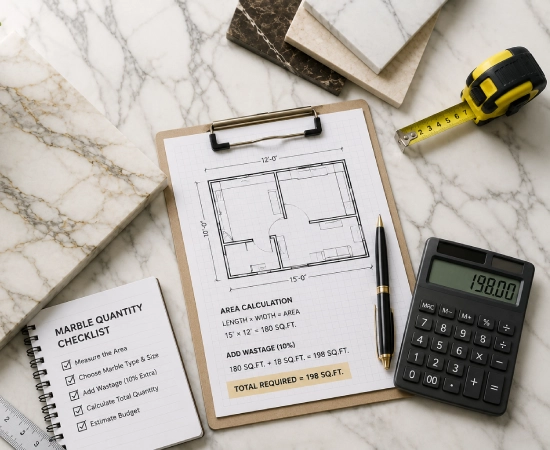
Selecting marble for your home is only one part of the process. Knowing how much material to order is equally important.
Order too little, and finding matching slabs later can be difficult because natural marble varies in colour and veining. Order too much, and you may unnecessarily increase your project budget.
Fortunately, understanding how to calculate marble quantity isn’t complicated. You need accurate measurements, an appropriate allowance for cutting and wastage, and a clear understanding of the slab sizes required for your design.
Here’s how to estimate your marble requirement before purchasing.
1. Calculate the Area in Square Feet
Use this formula:
Start by measuring the length and width of the floor.
Length × Width = Area in sq. ft.
For example, if a room measures 20 ft × 15 ft:
20 × 15 = 300 sq. ft.
Your basic marble requirement is therefore 300 sq. ft. before considering cutting and wastage.
For multiple rooms, calculate each room separately and add the figures together.
For wall cladding, multiply the wall’s width by its height. Large openings can be deducted where appropriate.
2. Measure Irregular Areas Separately
Not every room is a perfect rectangle. Passages, columns, niches, corners, and connected spaces can make a marble square feet calculation more complicated.
Divide an irregular floor into smaller rectangular sections, calculate each area separately, and then combine the results.
For complicated architectural spaces, it’s advisable to have measurements verified by your architect or installer before placing the final order.
3. Add Marble Wastage
Your measured area and purchase quantity usually won’t be identical.
Marble must be cut around corners, columns, doorways, and other architectural features. Certain offcuts may not be reusable, particularly when a specific vein direction or pattern is required.
For straightforward layouts, a planning allowance of approximately 5–10% may sometimes be used. More complex layouts, large-format pieces, diagonal patterns, or bookmatching can require additional material.
For example, if your measured area is 500 sq. ft. and your project requires a 10% allowance:
500 + 50 = 550 sq. ft.
The appropriate marble wastage percentage should always be confirmed with your installer or fabricator because every project is different.
4. Consider the Actual Marble Slab Size
Square footage isn’t the only number that matters.
Natural marble is supplied in slabs of particular dimensions. How efficiently those slabs can be cut into the required pieces determines the actual quantity you need to purchase.
A good marble slab calculation considers:
- Slab length and width
- Required finished-piece dimensions
- Vein direction
- Cutting requirements
- Natural characteristics to be avoided
- Pattern continuity
This becomes especially important with premium imported marble, where thoughtful slab planning can reduce unnecessary waste while preserving the intended design.
5. Calculate Stairs, Walls and Countertops Separately
Different applications require different calculations.
For flooring, calculate length × width and add the appropriate cutting allowance.
For wall cladding, multiply wall width × height and account for openings, corners, niches, and joints.
For stairs, calculate treads and risers separately. Landings, skirting, edge profiles, and fabrication requirements should also be included.
For countertops and vanities, slab dimensions are particularly important. Sink openings, cooktops, backsplashes, edge profiles, and vein direction can affect how much of a slab is usable.
Breaking the project into individual applications produces a more realistic marble flooring estimate.
6. Allow for Vein Matching and Design Patterns
If you’re choosing marble with prominent natural veining, the design itself can influence how much material is required.
For instance, a designer may want veins to continue naturally across adjoining floor sections or wall panels. A bookmatched feature wall requires suitable consecutive slabs to create its mirrored appearance.
In these cases, minimizing wastage shouldn’t be the only objective. Additional material may be necessary to achieve the intended visual composition.
This is one reason viewing full slabs before purchasing is valuable. Small samples show colour, but they don’t reveal the complete movement of natural veining.
7. Calculate the Overall Marble Budget
Once you’ve estimated the required quantity, you can create a preliminary material budget.
The basic formula is:
Required Marble Quantity × Marble Rate = Estimated Material Cost
However, material price alone doesn’t represent the complete project cost.
Depending on your quotation and project, additional expenses can include:
- Transportation and handling
- Cutting and fabrication
- Installation
- Grinding and polishing
- Edge finishing
- Skirting
- Adhesives or bedding materials
- Sealing or other surface treatments
A realistic marble cost calculation should therefore consider both the stone and the work required to install it correctly.
Common Marble Calculation Mistakes to Avoid
One of the biggest mistakes is purchasing exactly the measured square footage without considering cutting or wastage.
Other common errors include ignoring slab dimensions, forgetting staircase risers or skirting, overlooking vein direction, and assuming every portion of a natural slab will be usable.
Another issue is purchasing marble for different rooms at different times. Since marble is natural, later slabs from another block may vary in tone or veining.
Whenever possible, estimate the complete requirement before selecting the final slabs.
FAQs
1] How do I calculate marble quantity for flooring?
Ans: Multiply the room’s length by its width to calculate the area in square feet. Then add an appropriate allowance for cutting and wastage based on the layout and slab dimensions.
2] How much extra marble should I buy?
Ans: A planning allowance of around 5–10% may work for some straightforward installations, but there is no universal percentage. Complex layouts, vein matching, or special patterns can require more.
3] Does marble slab size affect the quantity required?
Ans: Yes. The dimensions of the slabs determine how efficiently the required pieces can be cut, which directly affects wastage and purchase quantity.
4] How do I calculate marble for stairs?
Ans: Calculate the surface area of the treads and risers separately. Include landings, skirting, edge details, and any additional fabrication requirements.
5] Should installation be included in the marble budget?
Ans: Yes. Your complete project budget should account for material, fabrication, transportation, installation, polishing, and other applicable finishing costs.
6] Plan Your Marble Purchase with Adi Marble
Ans: Knowing how to calculate marble quantity helps you control your budget, reduce unnecessary wastage, and avoid material shortages during installation. But accurate measurement is only the beginning. Slab dimensions, natural veining, cutting plans, and the intended application should also influence the final quantity.
At Adi Marble, homeowners, architects, and interior designers can explore premium marble and natural stone for flooring, staircases, walls, countertops, and bespoke interior applications.
📍 Visit Us: Chintamani Park Road, Borate Vasti, Tukaram Nagar, Kharadi, Pune, Maharashtra 411014
📞 Call Us: +91-9168633149
🌐 Website: https://adimarble.in
Step into elegance. Step into Adi Marble.